

Threat Hunting
Proactively Hunt. Detect Hidden Threats. Disrupt Attacks
Not every cyberattack generates an alert. Sophisticated attackers can evade traditional security controls, use legitimate administrative tools, operate with compromised credentials, and remain inside an environment for extended periods without triggering obvious alarms. Threat Hunting takes a proactive approach by actively searching for signs of malicious activity, suspicious behavior, and hidden threats that automated security controls may have missed.
- Intelligence-Driven Hunting
- Hypothesis & TTP-Based Hunting
- Endpoint & Network Hunting
- Living-off-the-Land Detection
- Identity & Cloud Hunting
- Detection Engineering
What’s included
Combine threat intelligence, behavioral analytics, security telemetry, and human-led investigation
- Intelligence-Driven Hunting
Use current threat intelligence to develop targeted hypotheses, identifying active campaigns, threat actor TTPs, and malicious infrastructure relevant to your industry and environment
- Hypothesis & TTP-Based Hunting
Hunt based on how attackers operate, credential dumping, lateral movement, persistence, defense evasion, and C2, using MITRE ATT&CK as a structured hunting framework
- Endpoint & Network Hunting
Deep-dive into EDR telemetry for process trees, command-line activity, and persistence, combined with NDR analysis for beaconing, C2 traffic, and lateral movement patterns
- Living-off-the-Land Detection
Identify attackers abusing legitimate OS utilities, PowerShell, WMI, scheduled tasks, and administrative tools, by focusing on suspicious execution context rather than tool signatures
- Identity & Cloud Hunting
Investigate compromised credentials through unusual authentication, privilege changes, and abnormal access patterns, extended into cloud environments for suspicious API activity
- Detection Engineering
Convert every successful hunt into a permanent, automated detection rule deployed into SIEM and EDR, so human-led discoveries become long-term monitoring capabilities
The technical flow
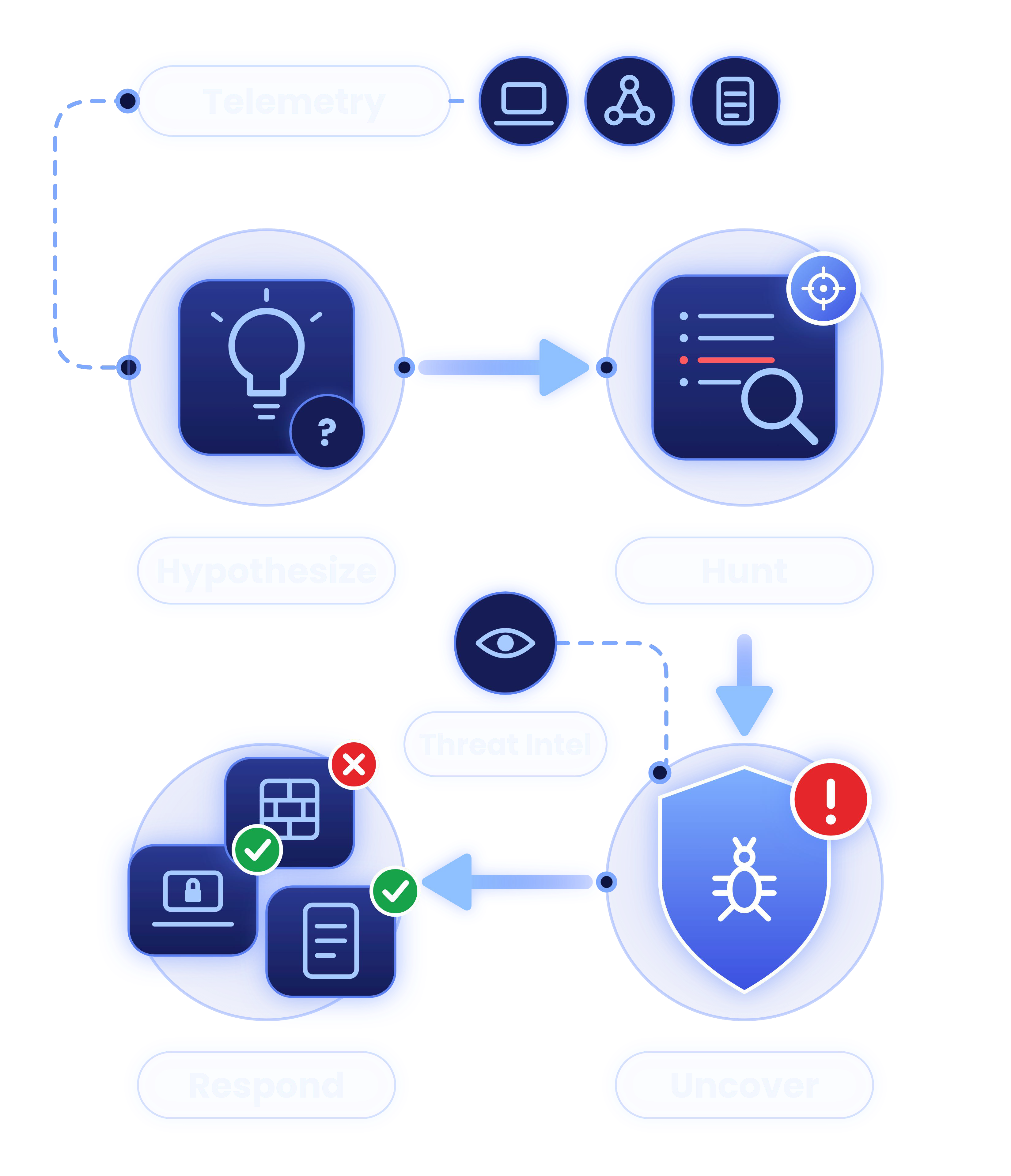
Environment & Threat Assessment
Map critical assets, architecture, and telemetry sources; identify relevant threat actors, TTPs, and campaigns targeting the organization
Hypothesis Development
Create specific, testable hunting hypotheses based on threat intelligence, known adversary behavior, and organizational risk
Proactive Hunting
Search endpoint, network, identity, cloud, and email telemetry for indicators, behaviors, and patterns aligned with the hypothesis
Investigate & Validate
Analyze suspicious findings, confirm scope, identify affected systems, and determine whether activity is malicious
Respond & Improve
Escalate confirmed threats for containment, convert findings into automated detections, and feed lessons learned back into the intelligence cycle
Engagement
How We Deliver It

What you gain
- Discover Hidden Threats
Uncover attackers operating below the alert threshold, using legitimate tools, stolen credentials, and fileless techniques that bypass automated controls
- Reduce Attacker Dwell Time
Identify intrusions weeks or months earlier than reactive security operations, limiting the time attackers have to achieve their objectives
- Improve Detection Coverage
Convert every hunt into permanent detection engineering, continuously strengthening SIEM and EDR rules based on real adversary behavior found in your environment
- Validate Security Controls
Determine whether existing security controls are effective, identifying gaps before an attacker exploits them
Technologies we work with
- MITRE ATT&CK MATRIX
- CUSTOM PYTHON / KQL QUERIES
- EDR FLIGHT RECORDERS
- KERNEL TELEMETRY
Standards & frameworks we align to
- MITRE ATT&CK
Ready to strengthen your Detection & Response posture?
Tell us what you’re protecting. We’ll help you secure it.